
Professional Tecartherapy is evolving towards new application methods, increasingly focused on treatment efficiency, workflow continuity and protocol personalization.
With Fisiowarm 7.0 and the UNIQ electrode, Tecartherapy introduces a simultaneous capacitive + resistive application mode in a single electrode, designed to move beyond the logic of traditional sequential treatment.
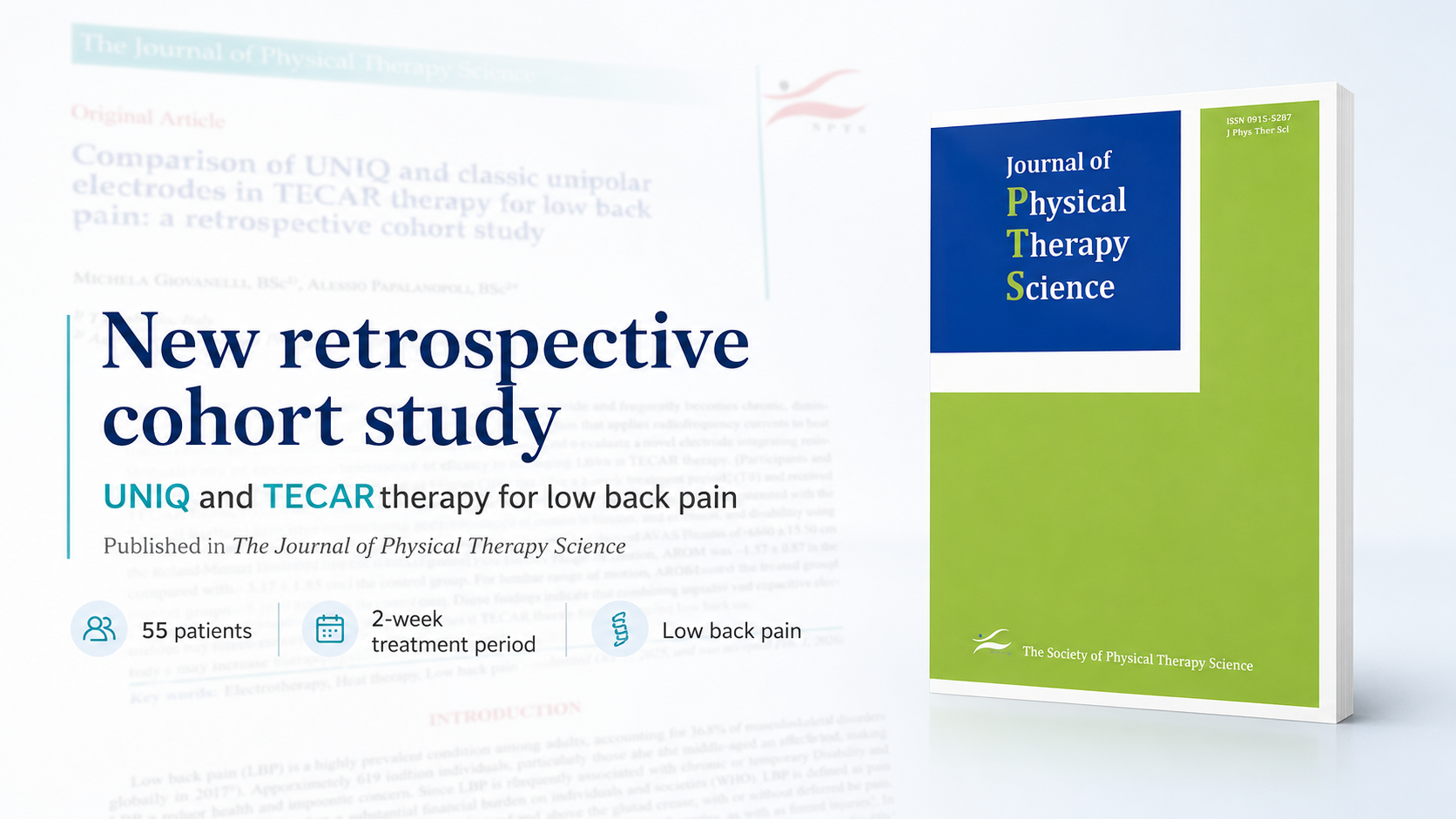
A new retrospective study published in the Journal of Physical Therapy Science analysed the use of UNIQ with Fisiowarm 7.0 in patients with low back pain, comparing the observed results with those obtained through traditional sequential electrodes.
Capacitive and Resistive Tecartherapy: From Sequential Protocol to Simultaneous Application
In traditional Tecartherapy, capacitive and resistive modes are usually applied at different stages of the treatment.
The capacitive mode is generally used to work on more superficial tissues and tissues with a higher water content, while the resistive mode is directed towards deeper tissues with greater resistance.
With UNIQ, these two energy modes are integrated into a single electrode, allowing simultaneous capacitive + resistive application with Fisiowarm 7.0.
This innovation allows professionals using Tecartherapy to work with a dual energy mode while maintaining a continuous treatment flow and reducing the need to alternate electrodes or application phases.
UNIQ with Fisiowarm 7.0: One Electrode, Dual Energy Mode
UNIQ is the electrode designed for use with Fisiowarm 7.0 and dedicated to simultaneous capacitive and resistive application.
Its function is to enable a smoother treatment workflow, integrating two modes that are normally applied sequentially into a single tool.
This characteristic makes UNIQ particularly interesting for daily clinical practice, where precision, application continuity and time management are important elements for physiotherapists and rehabilitation professionals.
The Study: UNIQ with Fisiowarm 7.0 in Low Back Pain
The study compared treatment with UNIQ + Fisiowarm 7.0 against a protocol using traditional sequential electrodes in patients with low back pain.
The analysed outcomes included:
pain using the VAS scale;
function using the Roland-Morris Disability Questionnaire;
lumbar mobility;
treatment time.
The objective was to observe the differences between simultaneous application with UNIQ and the traditional sequential protocol within the analysed sample.
Observed Results: Pain, Function, Lumbar Mobility and Treatment Time
In the group treated with UNIQ + Fisiowarm 7.0, favourable results were observed compared with the traditional sequential control group.
According to the data reported in the study:
VAS pain
UNIQ + Fisiowarm 7.0: –6.00 cm
Traditional control: –3.17 cm
Roland-Morris Disability Questionnaire
UNIQ + Fisiowarm 7.0: –11.47
Traditional control: –5.53
Lumbar mobility
UNIQ + Fisiowarm 7.0: –1.75
Traditional control: –1.16
Treatment time
UNIQ + Fisiowarm 7.0: 15 minutes
Traditional control: 20 minutes
In the analysed sample, these data indicate favourable results in the UNIQ group regarding pain, function, lumbar mobility and treatment duration.
UNIQ and Tecartherapy for Low Back Pain: A New Application Perspective
Low back pain is one of the most frequent conditions encountered in physiotherapy and rehabilitation practice.
In this context, the possibility of integrating the capacitive and resistive components into a single treatment may offer a new application perspective for professional Tecartherapy.
With Fisiowarm 7.0 and the UNIQ electrode, Tecartherapy can be applied through a simultaneous mode, designed to optimize workflow and make treatment more continuous compared with the traditional sequential protocol.
Simultaneous Tecartherapy: Efficiency and Continuity in Treatment
One of the relevant aspects observed in the study concerns treatment time.
In the UNIQ + Fisiowarm 7.0 group, the reported treatment time was 15 minutes, compared with 20 minutes in the traditional control group.
This is an interesting finding for clinical practice, because time management is a concrete element in the daily organization of physiotherapy clinics.
Simultaneous Tecartherapy with UNIQ should not be interpreted simply as a reduction in treatment duration, but as a different application method based on the simultaneous integration of capacitive and resistive components.
UNIQ and Fisiowarm 7.0: Technology Dedicated to Professional Tecartherapy
UNIQ is compatible with Fisiowarm 7.0 and has been developed to offer physiotherapists and rehabilitation professionals a specific tool for simultaneous capacitive and resistive Tecartherapy.
Its application allows a dual energy mode to be used in a single electrode, while maintaining an approach consistent with clinical assessment and treatment objectives.
The publication of data on UNIQ represents a further point of interest for professionals using Tecartherapy in daily practice and wishing to explore new application methods with Fisiowarm 7.0.
Request a UNIQ Demo with Fisiowarm 7.0
If you use Tecartherapy in your clinic or work in physiotherapy and rehabilitation, you can request a dedicated demo to try UNIQ with Fisiowarm 7.0.
The difference between the traditional sequential protocol and simultaneous application becomes clear when you try UNIQ during treatment.
Request a UNIQ demo with Fisiowarm 7.0
Scientific reference
Retrospective study published in the Journal of Physical Therapy Science, 2026, on the use of UNIQ + Fisiowarm 7.0 compared with traditional sequential electrodes in patients with low back pain.
Link to the scientific article
Note
The results reported refer to the published study and to the analysed sample. The information on this page is intended for healthcare professionals and does not replace the clinical assessment of the competent healthcare provider.